Hydraulics Channel GVF
Publié par Mohamed HAFIANE
Application used to compute water surface profiles in a prismatic channel for gradually varied flow.
Certaines parties de cette page apparaissent dans la langue dans laquelle elles ont été écrites, car la traduction n'est pas terminée.
Points clés
- Computes water surface profiles for gradually varied flow in prismatic channels.
- Describes how flow depth develops along a channel reach rather than at a single section.
- Focused on one class of open-channel calculation instead of general hydraulic modelling.
- Listed for Linux only, with no other platform given.
- Distributed under GPL-3.0-or-later, so the calculation method can be inspected and modified.
À propos de cette application
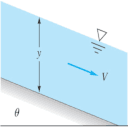
Hydraulics Channel GVF is a calculation tool for open-channel hydraulics. It computes water surface profiles along a prismatic channel, that is, a reach whose cross-section shape and bed slope do not change along its length, for the case of gradually varied flow: the regime in which depth changes slowly enough with distance that the flow can be treated as one-dimensional and the pressure distribution as hydrostatic at each section. The output of interest is how flow depth develops from one end of the reach to the other.
The scope is narrow by design. This is an aid for one class of problem rather than a general hydraulic modelling environment, which makes it relevant to civil and hydraulic engineering coursework and to practitioners who want a second computation of a backwater or drawdown profile alongside their own working.
The entry is published by Mohamed HAFIANE under the GPL-3.0-or-later licence, and Linux is the only platform listed, so users on other operating systems would need a Linux environment to run it. Because the licence is a copyleft one, the underlying computation can be read and adapted rather than taken on trust.
Où l’obtenir
Linux
- Ouvrir sur FlathubOuvre un nouvel ongletDépôt de paquetsFlathub
De l’éditeur
Installer depuis un terminal
flatpak install flathub io.github.hafmed.Hydraulics-Channel-GVF
Nous n’hébergeons pas ce fichier, nous ne l’analysons pas et nous n’en inspectons pas le contenu. Lisez ce qu’en dit la source, puis décidez par vous-même.